Codex is becoming a work surface, not just a coding agent
OpenAI's role-specific Codex plugins, hosted Sites, and annotations point to a broader shift from coding assistant to shared work surface.
Summary
OpenAI’s June 2 Codex update matters less because it adds another feature to an agent product and more because it changes where Codex sits in a team’s workflow. The release introduces role-specific plugins, shareable hosted Sites, and annotations for refining generated work. That combination moves Codex from “a coding assistant used by engineers” toward “a work surface where analysts, marketers, product teams, sales teams, investors, and developers can create artifacts together.”
The important product signal is that OpenAI is no longer presenting Codex as only a better way to edit repositories. It is positioning Codex as an execution layer for knowledge work: connected to enterprise tools, capable of producing dashboards and documents, and able to publish interactive workspaces that other people can review through a URL. That is a different adoption path. Instead of asking every team to learn agentic coding, OpenAI is packaging agent work around recognizable business roles.
For builders, the release should change the way agent products are evaluated. A capable model is now table stakes. The harder question is whether the product can preserve context, expose intermediate work, let humans revise exact parts of the output, and make the final artifact useful to a team that did not sit through the prompt session.
What happened
OpenAI announced new Codex capabilities aimed at making the product useful across more roles and workflows. The company says Codex now has more than five million weekly users, and that non-developers already account for roughly one fifth of usage while growing faster than developers. The update adds role-specific plugins for areas such as data analytics, creative production, product design, sales, public equity investing, and investment banking.
Those plugins bundle tools, skills, instructions, and workflows. The data analytics plugin connects to systems such as Snowflake, Databricks Genie, Hex, and Tableau. The creative production plugin touches tools such as Figma, Canva, Shutterstock, Picsart, and Fal. The sales plugin brings in systems such as Salesforce, HubSpot, Slack, Outreach, Clay, Rox, and Actively. This is not a narrow developer feature; it is an attempt to turn Codex into a role-aware operating surface.
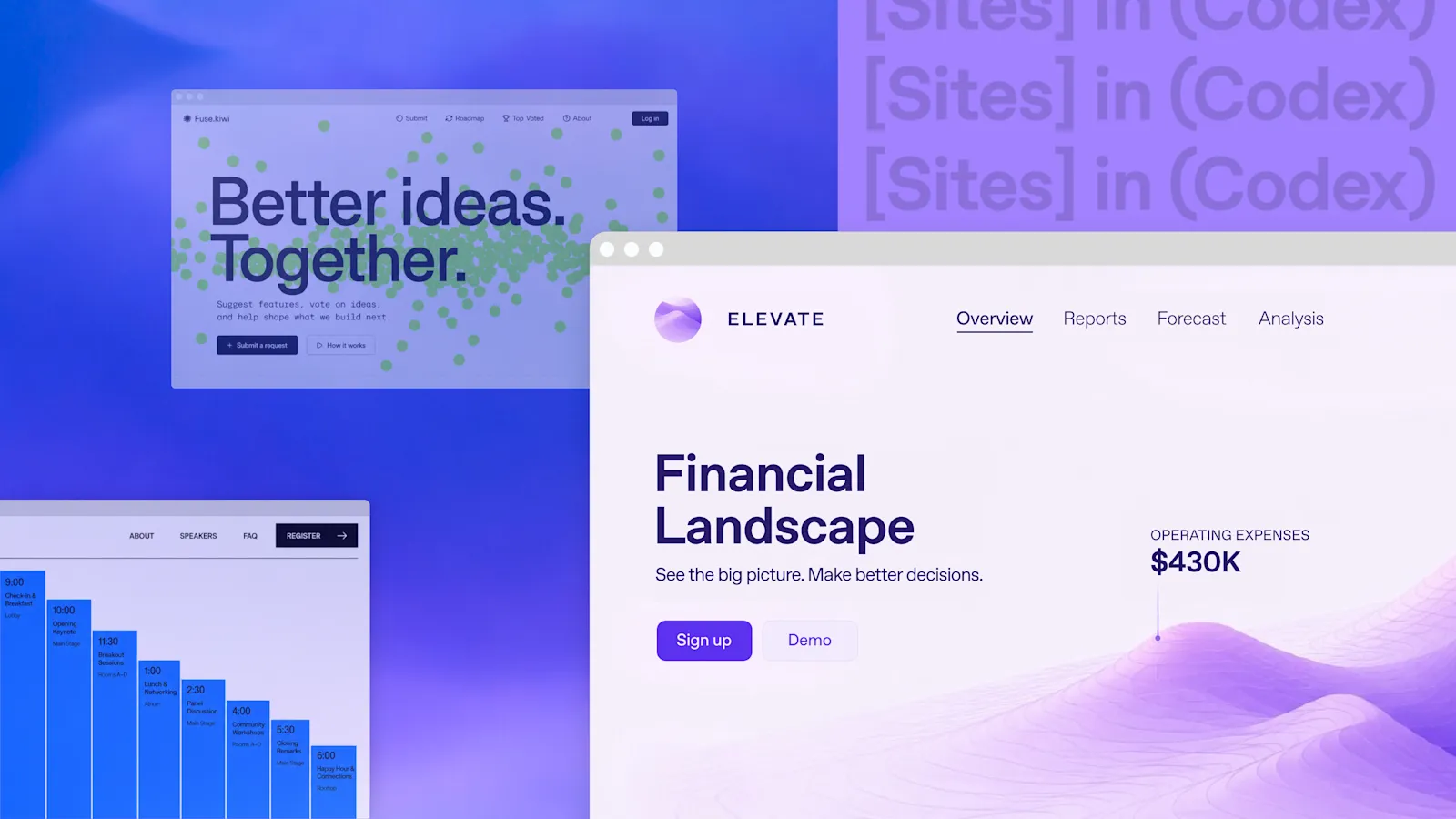
OpenAI also introduced Sites in preview for business and enterprise customers. Sites let Codex create interactive hosted websites or apps that can be shared inside a workspace. The examples are deliberately mundane: customer review pages, scenario planners, launch hubs, project boards, galleries, and lightweight tools. That mundane quality is the point. OpenAI is trying to make the output of an agent reviewable and reusable, instead of trapping it inside a chat transcript or a one-off file.
The third piece is annotations. Users can point to part of the generated work and ask Codex to change that exact part. OpenAI says this editing model now extends beyond code and websites into documents, spreadsheets, and slides. Put together, plugins define context, Sites make artifacts shareable, and annotations make revision local rather than conversationally vague.
Why it matters
The release is a useful marker for where frontier agent products are moving. The early phase of coding agents was about proving that a model could make changes across files and pass tests. The next phase is about making that ability legible to organizations. A team does not buy an agent because it can complete a benchmark; it buys an agent when the result lands inside an existing workflow with enough control, auditability, and social acceptance to be used repeatedly.
That is why Sites are more strategically interesting than the role plugin list. A generated internal app is not new as a demo, but a hosted, shareable, updateable workspace changes the collaboration model. If a sales team can ask Codex to build an account review surface, share it with the workspace, annotate sections, and keep it current as data changes, then Codex is competing with lightweight internal tools, spreadsheet workflows, slide decks, and parts of BI. It is not only competing with other coding agents.
The release also shows how OpenAI is responding to an uncomfortable truth about agent adoption: raw autonomy is rarely the bottleneck. The bottleneck is trust transfer. The person who prompted the agent may understand what happened, but everyone else needs a stable artifact, a clear revision path, and a way to judge whether the output reflects the team’s real data and constraints. Codex Sites and annotations are product answers to that trust transfer problem.
Technical takeaway
The technical takeaway is that agent infrastructure is becoming artifact-centric. Builders should watch for three capabilities: context packaging, artifact hosting, and precise revision. Context packaging means the agent knows the relevant tools, schemas, files, brand constraints, and business process before it starts. Artifact hosting means the output can exist outside the agent session as a page, dashboard, spreadsheet, or app. Precise revision means the human can edit a part of the artifact without re-prompting the whole job and risking unrelated drift.
This matters because most agent failures in production are not spectacular reasoning failures. They are interface failures. The agent produces something plausible but hard to inspect. It changes too much at once. It hides assumptions. It cannot be shared with a stakeholder who was not present during generation. It is hard to correct without restarting the task. OpenAI’s update does not prove those problems are solved, but it correctly identifies the surface area.
The plugin approach also implies that model capability and tool routing will be bundled more tightly. A data analytics plugin is not just a prompt; it encodes available tools, preferred workflows, and likely output formats. That bundling is attractive for enterprise buyers because it shortens setup time. It is risky for builders because it may turn generic agent frameworks into commodities unless they provide deeper governance, better domain memory, or more reliable execution.
Builder impact
Builders working on agent products should take this release as a warning against shipping “chat plus tools” as the whole product. The durable value is moving toward workflow packaging. A useful agent product needs to answer four questions: what role is this for, what systems does it touch, what artifact does it produce, and how does a human revise it?
If you are building for internal operations, this points toward smaller, opinionated workflows rather than general-purpose autonomy. A finance agent that produces a scenario planner with traceable assumptions is more useful than a chat agent that says it can analyze financial data. A sales agent that updates a shared account review page is more useful than one that generates a call summary in isolation. A product design agent that turns a live URL audit into a reviewable prototype is more useful than one that only writes suggestions.
The practical action is to design around artifacts from day one. Store the plan, source data, assumptions, generated output, revision history, and unresolved questions as separate objects. Even in a static-site or Git-based workflow, the same principle applies: the agent’s work should leave behind structured material that a person can inspect and another process can validate.
The competitive risk is that OpenAI is moving up the stack. If Codex can connect to common enterprise systems and publish shareable workspaces, many wrapper products will need sharper differentiation. The opportunity is that broad platforms still leave room for vertical depth. Regulated workflows, scientific work, engineering governance, procurement, medical review, and other high-stakes domains will need controls that a general plugin cannot fully provide.
Research impact
For researchers, the release is another sign that evaluating agents only on task completion is too narrow. The important measurements should include artifact quality, revision stability, context retention across updates, tool error recovery, and whether the output can be audited by someone who did not run the agent. A hosted Site that looks correct but loses provenance is not trustworthy. An annotation system that fixes the visible text while silently breaking assumptions is not adequate.
This also creates a harder benchmark problem. If agents are becoming role-specific and tool-rich, then isolated tests of reasoning ability will miss the product behavior that matters. A data analytics plugin should be evaluated on whether it asks for missing definitions, handles schema ambiguity, cites source tables, produces reproducible queries, and lets a reviewer challenge assumptions. A product design plugin should be evaluated on interaction quality, constraint following, visual coherence, and whether iteration improves rather than homogenizes the work.
There is also a human factors question. The more an agent produces complete workspaces, the more users may defer to the shape of the artifact. A polished dashboard can make weak analysis feel finished. A coherent launch hub can hide missing dependencies. Research on agent reliability needs to study not only model errors, but how artifact presentation changes human scrutiny.
Community signal
HN and Reddit discussions around recent GPT and Codex releases show a consistent pattern: users care less about headline capability than about limits, pricing, reliability, model availability, and whether the service package fits real work. In HN discussion of GPT-5.5, comments quickly moved from benchmarks to rollout timing, API access, cyber restrictions, usage limits, and the difficulty of reproducing benchmark claims on private data. On Reddit, Codex-versus-Claude discussions often collapse the model, app, subscription, tool limits, and company trust into one practical buying decision.
That community signal is useful because it exposes where enterprise agent products will be judged. It will not be enough for Codex Sites to generate impressive demos. Teams will ask whether the artifact can be exported, versioned, governed, deleted, audited, and kept inside security boundaries. They will ask whether plugin access is predictable, whether costs spike during long tasks, and whether the model changes behavior after an upgrade.
The strongest signal is not enthusiasm or cynicism. It is the repeated demand for reproducibility. People want to know whether a result that worked in a launch video works on their codebase, their CRM, their messy spreadsheet, and their internal approval process. That is the real market test.
What to ignore
Ignore the idea that this release proves non-developers no longer need software teams. It proves something narrower: OpenAI sees demand for agent-generated business artifacts, and it is packaging Codex to meet that demand. Most organizations will still need people who understand data quality, permissions, workflow design, review standards, and the difference between a useful internal tool and a polished but misleading page.
Also ignore the framing that Sites are just “AI-generated websites.” The strategic point is not web generation. It is shareable state. A URL gives the agent’s work a place to live, a thing to review, and a surface for collaboration. If the state is not reliable, governed, and connected to source systems, the site is only a nicer transcript.
Finally, ignore broad claims that role-specific plugins automatically create defensibility. Tool lists are easy to market and hard to operate. The value will come from how well these plugins handle permissions, missing context, tool failure, source citation, revision, and handoff. That is where builders should look for the real frontier.